

Back Pain According to the 5 Biological Laws
Back pain is one of the most widespread complaints today, yet according to the 5 Biological Laws developed by Dr. Hamer it is not a random disorder…

Have you ever heard of biological handedness? It isn’t simply the hand you write with, but a fundamental concept for anyone approaching the 5 Biological Laws. Picture your brain as a control centre that reacts in a specific way to certain emotional shocks or biological conflicts. Biological handedness tells us how and where that reaction will show up in your body.
We often confuse biological handedness with being right-handed or left-handed when writing. In reality, it is an innate brain dominance that shapes how your body responds to stressful events, which in the 5BL are called DHS (Dirk Hamer Syndrome).
Consider a key example: a person who is biologically right-handed will react to a separation conflict (such as the loss of a loved one or an emotional estrangement) very differently from someone who is biologically left-handed. This difference translates into the activation of specific brain hemispheres and, as a result, the involvement of particular organs.
There is a simple way to tell whether you are biologically right-handed or left-handed, and it has nothing to do with the hand you hold a pen with:
In rare cases, biological handedness can be altered by factors such as having undergone “neurological reprogramming” (for example, if as a child you were forced to write with the hand opposite to your natural inclination) or by significant traumas that occurred before or after birth.
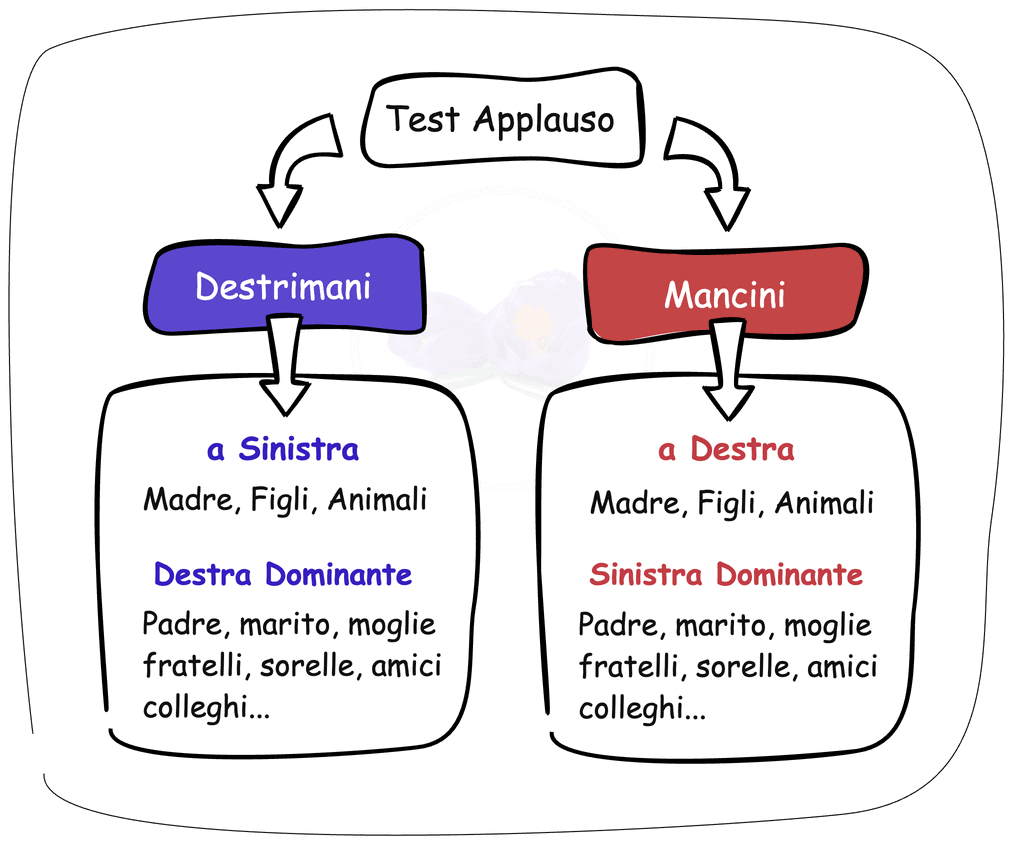
In the 5 Biological Laws, biological handedness is the key to interpreting on which side of the body (and therefore in which organ) the symptom linked to a given conflict will appear.
Let’s take a separation conflict as an example:
Let’s see how this concept applies to everyday situations:
According to the 5 Biological Laws, the exact location of a symptom on your body – whether it is eczema, a lump or shoulder pain – provides a further, crucial clue to the specific nature of the biological conflict that triggered it.
Understanding your own biological handedness, according to Germanic New Medicine, is essential because:
Biological handedness is a key piece of the puzzle for anyone who wants to explore the “language of the body” through the lens of the 5 Biological Laws, offering a unique perspective on how biological conflicts can manifest physically, in a view that always brings together psyche, brain and organs.
Back pain is one of the most widespread complaints today, yet according to the 5 Biological Laws developed by Dr. Hamer it is not a random disorder…
A synoptic table of tissues by body system, showing the correspondence between tissues, embryonic derivation (germ layers) and biological conflict…
To truly understand the common cold and rhinitis according to the 5 Biological Laws, we need to start from one fundamental principle…